At a Riyadh manufacturing company, new employees historically received their initial network password the same way for over a decade: printed on a slip of paper handed over at the front desk, with the username written right next to it. It worked — until a temporary contractor photographed a stack of these slips before they were shredded. This is exactly the kind of exposure that proper secure password delivery is designed to prevent.
Why Credential Delivery Is a Bigger Risk Than It Seems
Organizations invest heavily in firewalls, endpoint protection, and monitoring tools, yet often overlook one of the simplest attack vectors: how credentials reach the end user in the first place. Secure password delivery matters because a leaked initial password or reset code bypasses every downstream security control instantly — the attacker simply logs in as the legitimate user.
Common Insecure Practices to Eliminate
Several practices remain surprisingly common despite being well-known risks: emailing plaintext passwords, using predictable default passwords like “CompanyName@123,” printing credentials on paper, or sending both the username and password through the same unencrypted channel. Any organization serious about secure password delivery needs to eliminate all of these as a starting point.
“Read Also: Mover Process: Automating Permission Changes via AD Groups“
Modern Secure Delivery Mechanisms
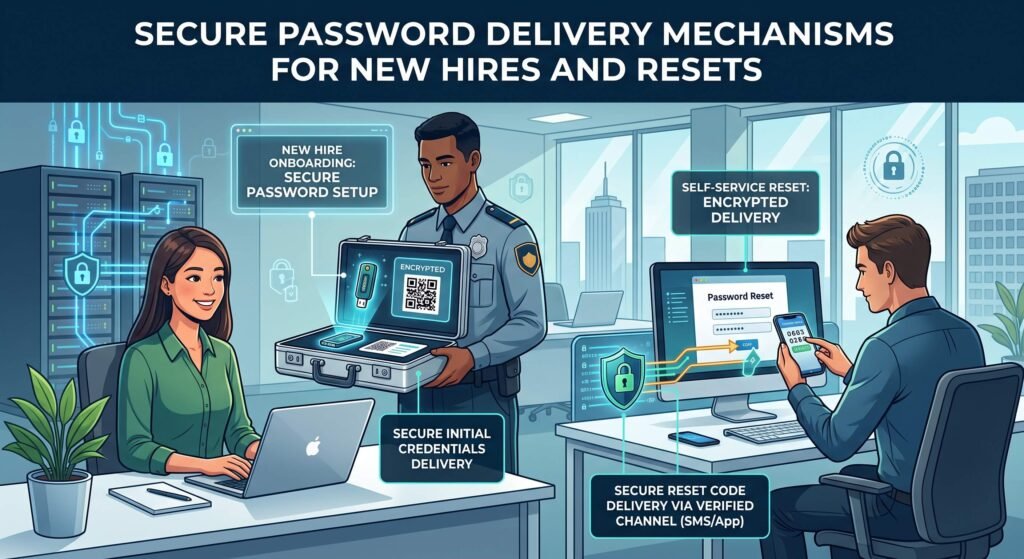
Effective secure password delivery today typically uses one or more of the following: a self-service portal where new hires set their own password after verifying identity through a pre-registered mobile number or personal email; SMS-based one-time codes for initial activation, separate from any static password; secure credential vaults that require the user to authenticate through a separate channel before revealing a temporary password; and integration with SSPR (self-service password reset) platforms that eliminate the need to transmit a password at all for resets.
Separating Channels for Username and Password
A core principle of secure password delivery is channel separation — never send the username and password through the same medium. A hospital network in Jeddah, for example, might send the username via the employee’s registered personal email while delivering a one-time activation code via SMS to their registered phone, ensuring that compromise of a single channel is not enough to gain access.
Time-Bound and Single-Use Credentials
Temporary passwords and reset codes should always be time-bound and single-use as part of any secure password delivery process. A password reset link or temporary code that remains valid indefinitely is effectively a standing vulnerability; setting a short expiration window (typically 15–60 minutes) and forcing immediate password change on first login dramatically reduces the exposure window.
“Read More: Automating IAM Rule Changes and Policy Enforcement via APIs“
Scaling Secure Delivery for Large Workforces
For enterprises with 10,000+ users — common among Saudi government entities, universities, and large retail groups — manual secure password delivery simply cannot scale. Automated workflows integrated with HR and self-service portals become essential, both to maintain security and to prevent the helpdesk from being overwhelmed with manual reset requests during peak onboarding periods.
Conclusion
Secure password delivery is one of the most underrated links in an organization’s security chain — a single weak step, like printing a password on paper, can undo every other control in place. By adopting channel separation, time-bound credentials, and self-service mechanisms, Saudi enterprises can close this gap without adding friction for employees.
Is your credential delivery process as secure as it should be? We help organizations design secure password delivery and self-service credential workflows that protect against credential-based attacks. Contact us for a security assessment.