
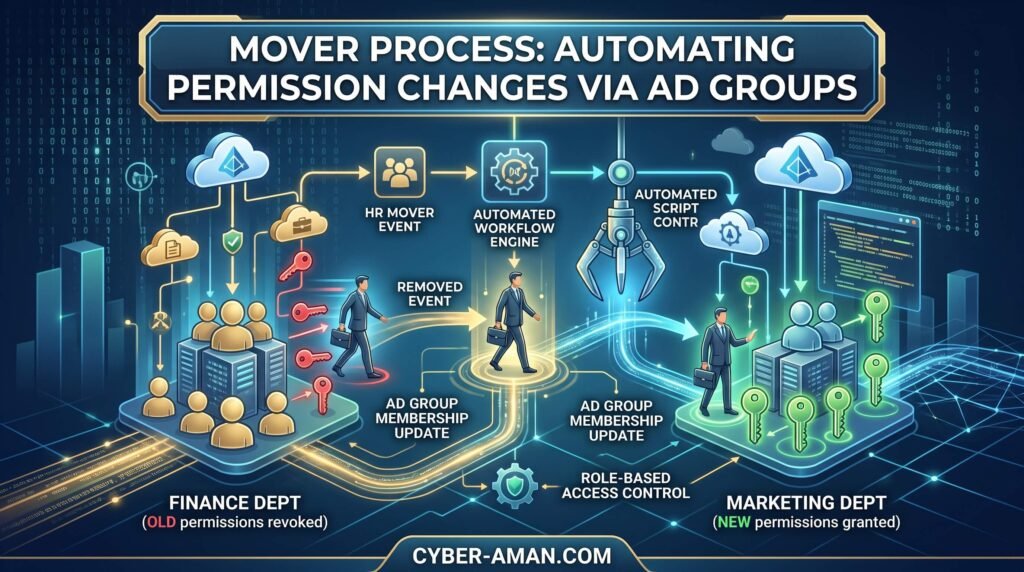
A finance manager at a Jeddah-based construction firm was promoted to Regional Controller last year. Nine months later, an internal audit found she still held full access to the accounts-payable approval group from her old role — access nobody remembered to remove, sitting alongside her new, broader permissions. This is the “mover” problem, and it is one of the most overlooked gaps that AD group automation for movers is specifically designed to close.
Why the Mover Process Gets Ignored
Most organizations build solid processes for new hires (joiners) and departing staff (leavers), because both events are visible and trigger clear actions. Movers — employees changing department, title, or location — are far less visible, especially in large enterprises where an internal transfer might not even involve IT or HR generating a formal ticket. Without AD group automation for movers, old access simply lingers, quietly accumulating into what security teams call privilege creep.
“Read Also: User Onboarding and Offboarding Through IAM API Integrations“
How Automated Group Membership Solves This
AD group automation for movers works by tying Active Directory group membership directly to attributes synced from HR — department code, job title, cost center — rather than to manual, one-time group assignments. When HR updates an employee’s department field, the automation engine re-evaluates group membership rules and both adds the new department’s groups and removes the old department’s groups in the same operation, rather than relying on an administrator to catch the change.
A Practical Example
Consider an employee moving from Sales to Marketing within a Riyadh retail company. With AD group automation for movers in place, the moment HR updates the department attribute, the employee is automatically removed from “Sales_SharePoint_Access” and “Sales_CRM_ReadWrite,” and automatically added to “Marketing_SharePoint_Access” and “Marketing_Campaign_Tools” — all without a helpdesk ticket, and without leaving behind the old Sales access that a manual process would almost certainly miss.
Preventing Access Creep and Audit Findings
Access creep — the slow accumulation of unused permissions as employees change roles over a career — is one of the most common findings in access certification audits, and one of the hardest to clean up after the fact, since nobody remembers why a given account holds a given permission years later. AD group automation for movers prevents this at the source by making access changes a direct, automatic consequence of an HR data change, rather than a task someone has to remember to perform manually.
Building the Rule Set
Implementing AD group automation for movers requires mapping each role or department to a defined set of group memberships up front — essentially formalizing what access “belongs” to each job function. This mapping exercise, while time-consuming initially, pays for itself immediately: it becomes the foundation for both automated mover handling and future access certification campaigns, since reviewers can compare actual access against the documented baseline for each role.
“Read More: Automating IAM Rule Changes and Policy Enforcement via APIs“
Handling Exceptions
Not every access grant fits neatly into a role-based template — some employees need temporary project access, for example. A well-designed AD group automation for movers approach separates role-based “birthright” access (fully automated) from exception-based access (manually requested, time-bound, and subject to periodic review), so automation handles the bulk of changes while exceptions remain visible and controlled.
Conclusion
The mover process is where most access-related risk quietly accumulates, precisely because it lacks the visibility of onboarding and offboarding. AD group automation for movers closes this gap by tying permissions directly to HR data, keeping access current, and eliminating the privilege creep that turns into painful audit findings months or years later.
Struggling with access creep from internal role changes? We help organizations design and implement automated mover processes that keep Active Directory permissions accurate at every stage of the employee lifecycle. Contact us to learn more.