
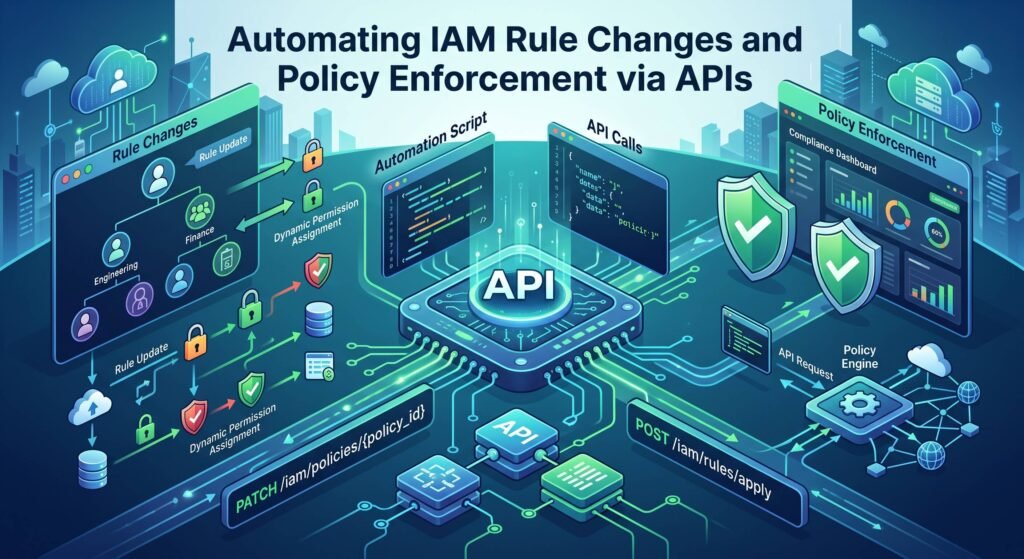
Imagine a Saudi telecom operator that just updated its remote-access policy: contractors can no longer access financial systems after 6 PM. Under a manual model, someone has to remember to adjust firewall rules, VPN group policies, and application-level permissions across a dozen systems — and inevitably, one system gets missed. With IAM policy automation, that same rule change propagates everywhere within minutes, through a single API call.
The Problem With Manual Policy Enforcement
Access rules rarely stay static. Regulations change, business units reorganize, and new threats emerge — each triggering a policy update that, without IAM policy automation, has to be manually replicated across every affected system by whoever remembers to do it. This is not just inefficient; it is a genuine compliance risk, since inconsistent enforcement across systems is exactly what auditors flag as a control failure.
“Read More: The Best IAM Products for Implementation in Saudi Arabia“
How API-Driven Policy Enforcement Works
IAM policy automation centralizes rule definitions in a policy engine — conditions like department, location, time of day, device type, or risk score — and pushes enforcement out to connected systems via APIs whenever a rule changes or a condition is evaluated. Instead of an administrator manually editing group memberships in five applications, the policy engine evaluates the rule once and calls each system’s API to apply the change consistently and simultaneously.
Real-World Examples in Saudi Enterprises
A retail group with e-commerce and in-store operations might use IAM policy automation to restrict warehouse staff accounts to specific working hours and specific IP ranges tied to their physical location, automatically loosening those restrictions during peak seasonal hiring without manual reconfiguration each time. A healthcare network, similarly, can enforce that clinical staff only retain access to patient record systems while actively rostered on shift — a rule that would be impossible to maintain manually across hundreds of staff.
Reducing Human Error Through Automation
Manual rule changes fail in predictable ways: someone forgets a system, applies the rule inconsistently, or grants broader access “temporarily” and forgets to revoke it. IAM policy automation removes this variability by treating policy as code — version-controlled, testable, and auditable — rather than as a series of undocumented manual edits scattered across administrators and systems.
Compliance and Audit Advantages
For organizations working toward NCA Essential Cybersecurity Controls or sector-specific frameworks, IAM policy automation produces something auditors specifically look for: a demonstrable, timestamped, system-wide record of exactly when a policy changed and how it was enforced across every connected application — rather than a patchwork of manual change logs that may or may not be complete.
“Read More: User Onboarding and Offboarding Through IAM API Integrations“
Getting Started With Policy Automation
Organizations new to IAM policy automation typically start by identifying their highest-risk, most frequently changed policies — privileged access time windows, contractor access restrictions, or segregation-of-duties rules — and automating those first via API integration before expanding to lower-risk policies across the rest of the environment.
Conclusion
As enterprises grow more complex, manually enforcing access policy across dozens of systems simply does not scale. IAM policy automation, built on API integration, gives Saudi organizations the consistency, speed, and auditability that both security and compliance teams need.
Want to eliminate manual policy enforcement across your systems? We help organizations design and implement API-driven IAM policy automation tailored to their compliance and security requirements. Contact us to get started.