
A university in Riyadh once discovered, during a routine audit, that 340 former staff and teaching assistants still had active domain accounts — some dating back four years. The root cause wasn’t negligence; it was architecture. HR recorded terminations in one system, IT disabled accounts manually in another, and the two never talked to each other. This is the exact problem IAM API integration was built to solve.
Why Manual Onboarding and Offboarding Fails at Scale
In organizations without IAM API integration, a new hire’s access is typically requested through a ticket, approved through email, and manually created by an administrator across five or six different systems — AD, email, VPN, ERP, and various line-of-business apps. Every manual step is a delay, and every delay is also a risk: accounts created too broadly “to be safe,” or disabled too late because nobody remembered.
“Read Also: Best Practices for Managing Active Directory in Modern Enterprises“
How API Integration Connects HR and IAM
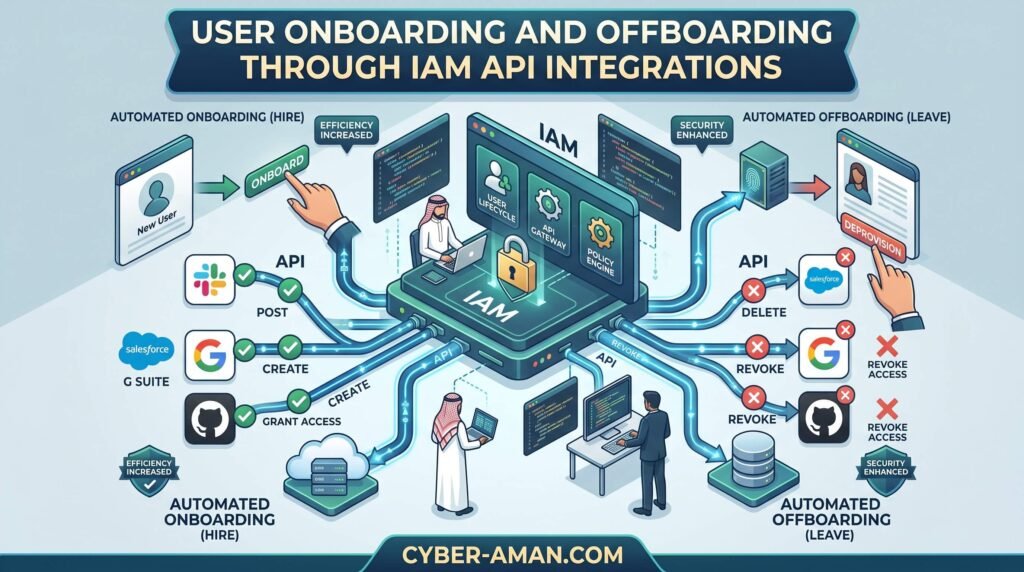
Modern IAM API integration connects your HR system — SAP SuccessFactors, Oracle HCM, or similar — directly to your identity platform and Active Directory. When HR marks a new hire as active, an API call automatically triggers account creation, attribute population (department, manager, employee ID), group membership assignment based on role, and provisioning across connected applications — all within minutes instead of days.
The reverse process matters just as much. When HR marks an employee as terminated, that same IAM API integration should trigger immediate account disablement, session termination across connected apps, and removal from security groups — closing the exact gap that left 340 stale accounts active at that Riyadh university.
Handling the “Mover” Scenario
Joiners and leavers get most of the attention, but role changes — movers — are just as important to automate through IAM API integration. When an employee transfers from Finance to Procurement, their old department access should be removed automatically as their new access is granted, rather than accumulating both sets of permissions indefinitely, which is one of the most common sources of excessive access found during audits.
Designing a Reliable Integration Architecture
A well-designed IAM API integration typically follows an event-driven model: the HR system publishes a change event, a middleware or IAM platform consumes it, validates the data against defined business rules, and pushes provisioning actions to downstream systems via REST APIs. Building in error handling and reconciliation reporting is essential — if an API call fails silently, you’re back to manual gaps. Scheduled reconciliation reports comparing HR records against AD accounts act as a safety net for anything the real-time integration might miss.
“Read More: The Best IAM Products for Implementation in Saudi Arabia“
Measurable Benefits
Organizations that implement mature IAM API integration typically see onboarding time drop from days to minutes, a dramatic reduction in orphaned or stale accounts, fewer helpdesk tickets related to access requests, and — critically for Saudi enterprises under NCA and sector-specific scrutiny — a clean, automated audit trail proving that access follows employment status in near real time.
Conclusion
IAM API integration transforms onboarding and offboarding from a manual, error-prone process into a reliable, auditable, near-instant workflow. For enterprises managing hundreds or thousands of identity changes each month, this isn’t a convenience — it is a fundamental security control.
Looking to automate your onboarding and offboarding workflows? We design and implement IAM API integrations that connect your HR systems to Active Directory and your business applications. Contact us to discuss your identity lifecycle automation project.