
Picture the IT team at a growing Riyadh-based logistics company. Over eight years, three system administrators have come and gone. Nobody documented why “Sales_Temp_2019” OU still exists, why forty accounts belong to a group called “Test — Delete Later,” or why a former employee’s account is still enabled with domain admin rights. This is not a rare horror story — it is the default state of Active Directory in thousands of enterprises across the Kingdom. And it is exactly why Active Directory management deserves far more attention than it usually gets.
Active Directory sits at the center of almost every Windows-based enterprise: it authenticates your staff, authorizes their access to file shares and applications, and enforces the security policies that protect your organization’s data. When Active Directory management is neglected, the risks multiply quietly — until an audit, a breach, or an NCA compliance review brings them into the light. Let’s walk through what disciplined Active Directory management actually looks like, with examples any Saudi enterprise will recognize.
Why Active Directory Management Matters More Than Ever
With the National Cybersecurity Authority’s Essential Cybersecurity Controls (ECC) pushing organizations toward stronger identity governance, Active Directory management is no longer a back-office chore — it is a compliance requirement. A poorly managed AD environment is one of the first things an auditor or a penetration tester will exploit, because stale accounts, excessive permissions, and undocumented group nesting are exactly where attackers hide.
“Read More: SAMA Ethical Red Teaming Guidelines“
Organizing Organizational Units (OUs) the Right Way
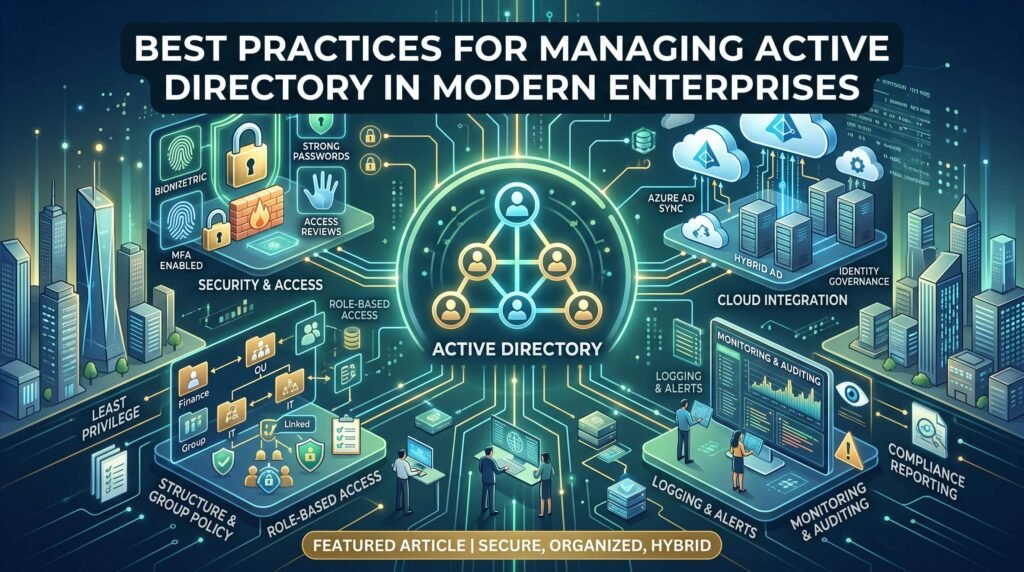
Good Active Directory management starts with OU structure. Many Saudi enterprises still organize OUs by department name alone — “Finance,” “HR,” “IT” — without factoring in branch locations, employee types, or Group Policy needs. A hospital network with sites in Riyadh, Jeddah, and Dammam, for example, benefits from a structure that reflects both geography and function, so that Group Policy Objects (GPOs) for workstation lockdown, password policy, and software deployment can be applied precisely to the right population without collateral effects on unrelated users.
A practical rule for Active Directory management: design OUs around how policy and delegation actually need to be applied, not around the org chart on a PowerPoint slide. Org charts change quarterly; delegation needs change far less often.
Managing Attributes With Discipline
Every user object in AD carries dozens of attributes — Employee ID, department, manager, mobile number, expiration date — and in most environments, half of them are inconsistent or empty. This becomes a serious problem the moment you try to integrate AD with an HR system, a mailing platform, or an IAM solution, because automation depends on clean, standardized attribute data. A retail chain in Jeddah rolling out SAP SuccessFactars integration, for instance, cannot automate onboarding if EmployeeID values are duplicated or missing across hundreds of accounts.
Strong Active Directory management means defining a mandatory attribute schema, validating it during account creation, and running regular reports to catch duplicates, blank fields, or mismatches before they break downstream systems.
“Read Also: SAMA Compliance Audit Requirements: Guide for KSA Entities“
Maintaining Directory Hygiene
Directory hygiene is the ongoing discipline of Active Directory management: disabling accounts the moment an employee leaves, removing stale computer objects, cleaning up unused security groups, and reviewing nested group memberships that nobody remembers creating. Left unchecked, these accumulate into what security teams call “identity debt” — and identity debt is precisely what attackers exploit during lateral movement after an initial breach.
A simple, repeatable hygiene routine works well for most organizations: monthly reports on inactive accounts (90+ days), quarterly reviews of privileged group membership, and an automated process — ideally API-driven — that disables accounts the same day HR marks an employee as terminated.
Building a Sustainable Active Directory Management Framework
The enterprises that get Active Directory management right treat it as a living framework, not a one-time cleanup project. That means documented OU standards, attribute governance rules, scheduled hygiene audits, and role-based delegation so that junior admins cannot accidentally grant domain-wide permissions. It also means treating AD as a security asset that deserves the same monitoring and reporting rigor as your firewall or your SIEM.
Conclusion
Active Directory management is not glamorous work, but it is foundational. Every identity governance program, every Zero Trust initiative, and every compliance framework in Saudi Arabia ultimately rests on how clean, structured, and well-governed your Active Directory really is. Get the fundamentals right — OUs, attributes, hygiene — and everything you build on top of AD becomes measurably more secure.
Need help auditing or restructuring your Active Directory environment? Our team specializes in Active Directory management, IAM implementation, and compliance readiness for enterprises across Saudi Arabia. Contact us today for a consultation and let us help you build a directory structure that is secure, clean, and audit-ready.