
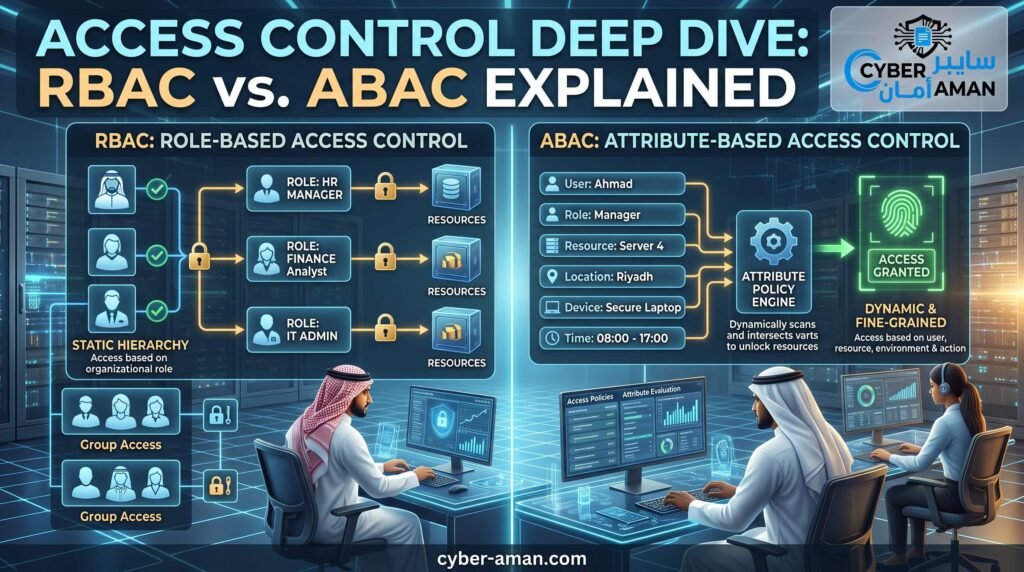
When a Saudi construction conglomerate tried to model access for its 6,000 employees using only job titles, it quickly hit a wall: two employees with the identical title of “Project Engineer” needed completely different access depending on which project, site, and client they were assigned to. This is a classic case where the RBAC vs ABAC decision matters enormously — and where a pure role-based model starts to break down under real-world complexity.
Understanding Role-Based Access Control (RBAC)
Role-Based Access Control assigns permissions based on a user’s defined role within the organization — a “Finance Manager” role automatically receives access to budgeting tools and approval workflows, while an “HR Coordinator” role receives access to the HR information system. In the RBAC vs ABAC comparison, RBAC’s biggest strength is simplicity: roles are easy to define, easy to audit, and easy for reviewers to understand during access certification campaigns.
Understanding Attribute-Based Access Control (ABAC)
Attribute-Based Access Control instead evaluates a combination of attributes — department, project assignment, location, clearance level, time of day, even device type — to make dynamic access decisions in real time. In the RBAC vs ABAC comparison, ABAC’s strength is precision: it can express access rules that would require an unmanageable number of roles to replicate accurately, such as “engineers can access project files only for projects they are currently assigned to, only during active project status.”
“Read Also: IAM as the Foundation of a Zero Trust Security Architecture“
Where RBAC Works Best
For organizations with relatively stable, well-defined job functions — a bank branch network, a manufacturing plant with clear departmental structure — RBAC vs ABAC tends to favor RBAC, since roles map cleanly to access needs and rarely change dramatically. RBAC is also generally easier to implement, audit, and explain to non-technical stakeholders, which matters when access certification reviewers are business managers rather than IT specialists.
Where ABAC Becomes Necessary
Organizations with project-based work, multiple clients, shifting team assignments, or highly granular regulatory requirements often find the RBAC vs ABAC comparison tips toward ABAC, or at least a hybrid model. A consulting firm working across multiple confidential client engagements, for instance, cannot reasonably create a unique role for every possible client-project-seniority combination — attribute-based rules handle this dynamic complexity far more gracefully.
The Hybrid Approach Most Enterprises Actually Use
In practice, the RBAC vs ABAC decision is rarely all-or-nothing. Most mature enterprises use RBAC for baseline, birthright access tied to job function — email, core applications, standard file shares — while layering ABAC on top for context-sensitive, high-sensitivity resources, such as financial systems, client-specific data, or privileged infrastructure access. This hybrid model balances RBAC’s auditability with ABAC’s precision where it matters most.
“Read More: Implementing Self-Service Password Reset (SSPR) AD Users“
Compliance Implications in Saudi Arabia
For Saudi enterprises navigating NCA Essential Cybersecurity Controls and PDPL requirements, the RBAC vs ABAC choice affects how easily an organization can demonstrate least-privilege access. ABAC, done well, can enforce far more precise least-privilege boundaries — but it also requires more mature attribute governance and more sophisticated policy engines to implement and audit correctly than a straightforward RBAC model.
Conclusion
Neither side of the RBAC vs ABAC debate is universally “better” — the right choice depends on how stable your roles are, how complex your access requirements are, and how mature your identity data and policy infrastructure currently are. Most Saudi enterprises ultimately land on a hybrid model that uses each approach where it fits best.
Not sure whether RBAC, ABAC, or a hybrid model fits your organization? We help enterprises design access control models that balance simplicity, precision, and compliance requirements. Contact us for an access control assessment.