
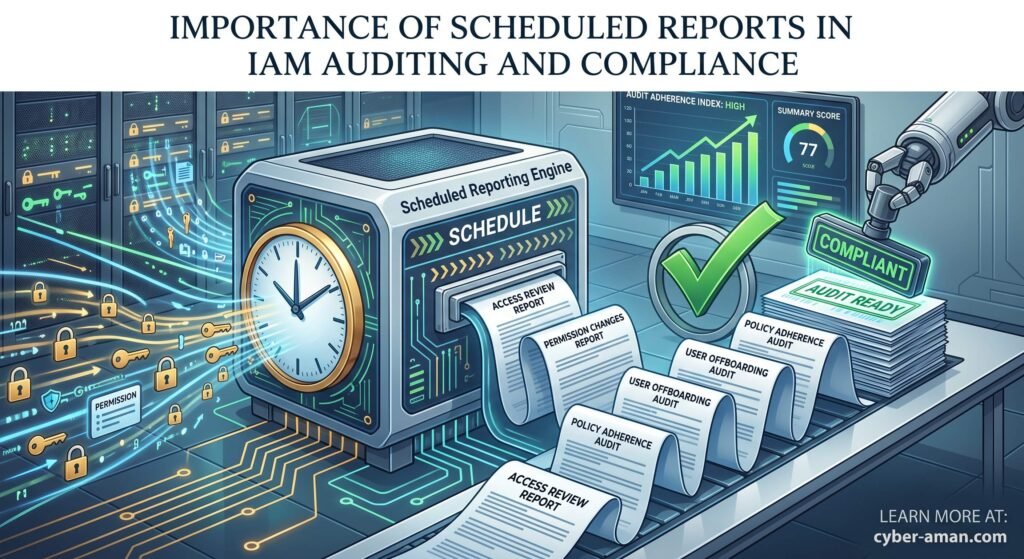
When NCA auditors arrived at a Saudi energy company for a scheduled compliance review, the IT security lead was asked a simple question: “Show me every privileged action performed on your domain controllers in the last 90 days.” Without IAM scheduled reporting already in place, that request would have meant days of manual log extraction. Because the reports were already automated and running weekly, the answer was ready in minutes.
Why Manual Reporting Fails Under Pressure
Ad-hoc reporting — pulling data only when someone asks — creates two problems: it’s slow when you need it most (during an active audit or incident investigation), and it’s unreliable, since manually assembled reports are prone to gaps and inconsistency. IAM scheduled reporting solves both by generating the same structured reports automatically, on a fixed cadence, whether or not anyone has asked for them yet.
What to Report On
A mature IAM scheduled reporting program typically covers several categories: current permissions and group memberships across critical systems, inactive and dormant accounts (commonly flagged at 30, 60, and 90 days of inactivity), administrative and privileged account actions, failed login attempts and lockouts, and changes to security-critical groups like Domain Admins. Each of these maps directly to something an auditor, security analyst, or compliance officer will eventually ask about.
“Read Also: Identity Governance: How to Run Access Certification Campaigns“
Tracking Inactive and Dormant Accounts
Inactive accounts are one of the highest-value targets for IAM scheduled reporting, since dormant accounts with valid credentials are a favorite target for attackers precisely because nobody is watching them. A scheduled report flagging any account inactive for 60+ days — cross-referenced against HR employment status — lets IT proactively disable accounts before they become a liability, rather than discovering them during an incident response.
Monitoring Administrative Actions
Privileged accounts carry the highest risk in any environment, and IAM scheduled reporting should specifically track changes made by administrators: new accounts created, group memberships modified, password policies changed, and permissions escalated. A weekly digest of privileged activity, delivered automatically to a security lead, catches unauthorized or suspicious changes far faster than relying on someone to notice during a routine review.
Building Reports Auditors Actually Want
Not all reporting is equally useful for compliance purposes. Auditors working within Saudi frameworks like NCA ECC or SAMA CSF typically want to see evidence of consistency (the same report, run on the same schedule, over time) and traceability (who has what access, when it was granted, and by whom). IAM scheduled reporting designed with these expectations in mind — rather than generic, one-off exports — dramatically shortens audit cycles.
Automating Distribution and Escalation
The final piece of effective IAM scheduled reporting is distribution: reports should land automatically in the inboxes of the people accountable for acting on them, with clear escalation if a flagged item (like a dormant privileged account) isn’t addressed within a defined window. This turns reporting from a passive record-keeping exercise into an active control that drives remediation.
Conclusion
IAM scheduled reporting turns compliance from a scramble into a routine. When permissions, administrative actions, and inactive accounts are tracked automatically and consistently, audits become a matter of retrieving existing evidence rather than assembling it under deadline pressure.
Want audit-ready IAM reporting without the manual effort? We help Saudi enterprises design and automate scheduled IAM reports for auditing, compliance, and security monitoring. Contact us to discuss your reporting needs.