
Imagine walking into a bustling digital bank branch in Riyadh or processing a massive volume of real-time transactions through a fintech app during the peak of the Saudi National Day celebrations. Behind the seamless convenience of modern digital banking in the Kingdom lies a relentless, invisible battleground. Cyber threats never sleep, and for institutions operating within Saudi Arabia’s booming economy, protecting customer data and financial assets is not just an IT priority—it is a national regulatory mandate.
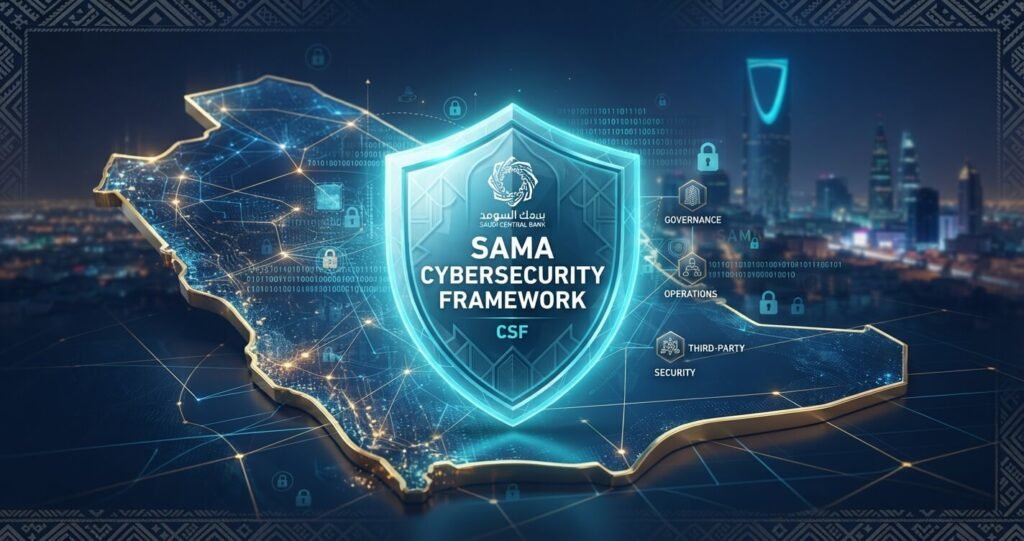
Enter the SAMA cybersecurity framework. Issued by the Saudi Central Bank (formerly known as the Saudi Arabian Monetary Authority), this robust regulatory model is designed to safeguard the Kingdom’s financial ecosystem against sophisticated cyber threats. Whether you run a commercial bank in Jeddah, an insurance firm in Riyadh, or an emerging payment gateway, understanding and implementing the SAMA cybersecurity framework is the ultimate key to operational survival and compliance.
In this comprehensive guide, we will break down what the SAMA cybersecurity framework entails, its core domains, maturity targets, and how your organization can achieve compliance seamlessly.
What is the SAMA Cybersecurity Framework (CSF)?
The SAMA cybersecurity framework is a comprehensive set of mandatory rules, principles, and technical controls established to create a unified, secure baseline across all financial sector entities in Saudi Arabia. Unlike generic international guidelines, the SAMA cybersecurity framework is tailor-made to address the unique risk landscapes and regulatory expectations of the Saudi financial market.
“Read More: Complete Guide to SDAIA Data Privacy Regulations“
Who Must Comply?
The mandate applies broadly across the Kingdom’s financial architecture. Key entities obligated to adopt the SAMA cybersecurity framework include:
- Commercial and investment banks
- Insurance and reinsurance companies
- Financing and credit companies
- Credit bureaus and payment service providers (Fintechs)
- Financial Market Infrastructure institutions
The Four Core Domains of the SAMA Cybersecurity Framework
To successfully navigate implementation, organizations must address four main pillars. The SAMA cybersecurity framework structures its requirements across these essential domains:
- Cybersecurity Leadership and Governance: Establishes board-level accountability. Cybersecurity cannot sit solely within the IT department; it requires executive oversight, a dedicated Chief Information Security Officer (CISO), and clear internal policies.
- Cybersecurity Risk Management and Compliance: Requires organizations to continuously identify, assess, and manage cyber risks. This involves maintaining an accurate asset inventory and a dynamic risk register.
- Cybersecurity Operations and Technology: Focuses on the technical defenses. Under the SAMA cybersecurity framework, entities must deploy robust identity and access management (IAM), multi-factor authentication (MFA), vulnerability management, and 24/7 security event monitoring.
- Third-Party and Cloud Computing Security: Because modern enterprises rely heavily on external vendors, this domain ensures that third-party suppliers, cloud providers, and outsourced IT partners meet the strict security standards dictated by the SAMA cybersecurity framework.
Understanding SAMA Maturity Levels
Achieving compliance with the SAMA cybersecurity framework is not a simple check-the-box exercise. SAMA evaluates institutions using a progressive five-stage maturity model (Levels 0 to 5):
- Level 0-2 (Non-existent to Ad-hoc): Informal and unmeasured controls. (Unacceptable for regulated entities).
- Level 3 (Structured and Formalized): The baseline target mandated by SAMA. Policies and controls must be formally documented, approved, and fully implemented.
- Level 4 & 5 (Managed, Measurable, and Adaptive): Advanced states where organizations continuously measure control effectiveness using Key Performance Indicators (KPIs) and adapt proactively to emerging threat intelligence.
Real-World Example: For instance, simply having a password policy on paper satisfies Level 2. However, proving that multi-factor authentication is actively enforced, logged, and periodically audited across 100% of remote worker sessions pushes your organization securely into Level 3 and beyond.
“Read More: Ultimate PDPL Compliance Roadmap KSA: Step-by-Step Guide“
Practical Steps for Successful SAMA Compliance
Implementing the SAMA cybersecurity framework demands a structured roadmap:
- Conduct a Gap Assessment: Compare your current security posture against SAMA controls to highlight vulnerabilities and missing technical defenses.
- Define Scope and Assign Ownership: Appoint a qualified CISO and map out critical assets, payment gateways, and core customer databases.
- Deploy Technical Controls: Enforce strict access privileges, network segmentation, encryption, and real-time logging.
- Continuous Monitoring and Audits: Prepare regular compliance reports and schedule independent penetration tests to validate your defenses.
Secure Your Organization Today with Expert Consulting
Navigating the complexities of the SAMA cybersecurity framework can be a challenging journey for internal teams juggling day-to-day IT operations. From performing precise gap analyses to achieving targeted maturity levels and preparing for regulatory audits, having the right guidance makes all the difference.
Are you looking to streamline your regulatory journey and ensure complete compliance? You can contact us today to help you with this compliance process and provide expert consultation tailored specifically to your organization’s needs. Let us help you build long-term operational resilience in the Saudi market!